
Lab Sync expands its San Diego facility to scale delivery of HoverLabs and mobile robotics
More build and integration space lets us assemble, test, and validate more systems at the same time rather than one at a time. This is a capacity story, not a real estate story.
One connected floor.
Lab Sync is growing, and our space has grown with it. We have expanded our San Diego facility, more than doubling our footprint from 2,094 to 4,587 square feet by adding 2,493 square feet of adjacent space that connects directly into our existing floor. The added room changes what we can deliver for the labs we build for.
We want to be clear about why this is worth an announcement at all, because a company talking about its own building is not inherently interesting. This is a capacity story, not a real estate story. Square footage matters here only because of a specific constraint it removes, and that constraint has been shaping how quickly we can get systems into labs. Here is what the expansion makes possible.
What theexpansionchanges.
- 01This is a capacity story, not a real estate story.Square footage is only interesting because of what it lets us build and ship.
- 02Parallel beats sequential.The constraint on delivery has not been engineering effort. It has been floor space, because systems had to move through the build and test area one at a time. More area means more in progress at once.
- 03Each platform gets more room to grow.HoverLabs and the Mobile Robot Lab Assistant both get more room to build, integrate, and test, so growth in one line no longer crowds the other.
- 04Custom builds get more room.More space to take on custom and integrated systems shaped around a specific lab, alongside our core platforms.
- 05Seeing it run is the fastest way to trust it.The added room means more customers can watch both platforms working in person. A customer demonstration space is currently being completed.
- 06Capacity is only as good as the team using it.The people building in this space have collectively placed more than 30 mobile robots over their careers.
The constraint was never the engineering
When a lab asks how soon a system can be delivered, the honest answer has rarely been about design or engineering effort. Our team can design a workcell, size the transport layer, and specify the integration well ahead of when the floor can take it. The binding constraint has been physical.
An automation system is not something you assemble on a desk. It needs a footprint for the duration of its build, and then it needs that same footprint for integration and testing, because the point of testing is to run the system as the customer will run it, with the real devices in the real arrangement. That space stays occupied from kickoff to crate. Two systems that need the same bay do not get built at the same time. They get built one after the other, and the second project waits for reasons that have nothing to do with its complexity.
It is a quiet constraint, which is part of why it is worth naming. Nobody sees it on a quote. It does not appear in a specification. It shows up only as a date, and the date looks like a choice we made rather than a queue we were managing.
Demand for both of our platforms has grown faster than a single build floor can hold. Once you understand that, the expansion stops being about square footage and starts being about how much work we can carry at once. More build and integration space means we can assemble, test, and validate more systems at the same time rather than moving them through in sequence. For customers, that means more of our team and our capacity available for the work, and it is intended to support faster delivery.
Lab Automation, Delivered Faster.
Our tagline is Lab Automation, Delivered Faster. This expansion is that promise grounded in capacity.
Why now
Two things converged, and neither of them was a plan to get a bigger building.
The first is that both product lines grew at once. That is a good result and an awkward one. A single line growing quickly can be absorbed by working longer hours and sequencing carefully. Two lines growing at the same time cannot, because the thing they are competing for is not hours. It is floor. We reached the point where the calendar was full of decisions about which project got the bay, and those decisions were being made weekly by people who should have been solving engineering challenges instead.
The second is that the nature of the requests changed. Labs used to ask us to automate a step. Increasingly they ask us to automate a workflow, which means more devices, more integration, more transport, and a larger physical arrangement to build and prove out. A workcell that spans a room takes a room to test. As the scope of what customers are asking for has grown, so has the space each project needs while it is with us.
Add those together and the shape of the constraint becomes obvious. We were not short on capability or on demand. We were short on floor, and being short on floor was quietly turning into longer waits for customers.
Room for both platforms to scale
The expansion gives each of our platforms room to grow without crowding the other. That sounds like a small thing. In practice it is one of the more important consequences of the expansion.
When two product lines share a floor, they compete for it, and the competition is decided by whichever has the more urgent deadline that month. That is a reasonable way to make a decision and a poor way to run a roadmap. A quarter of heavy demand on one line quietly slows the other, and nobody plans for it because nobody chose it.
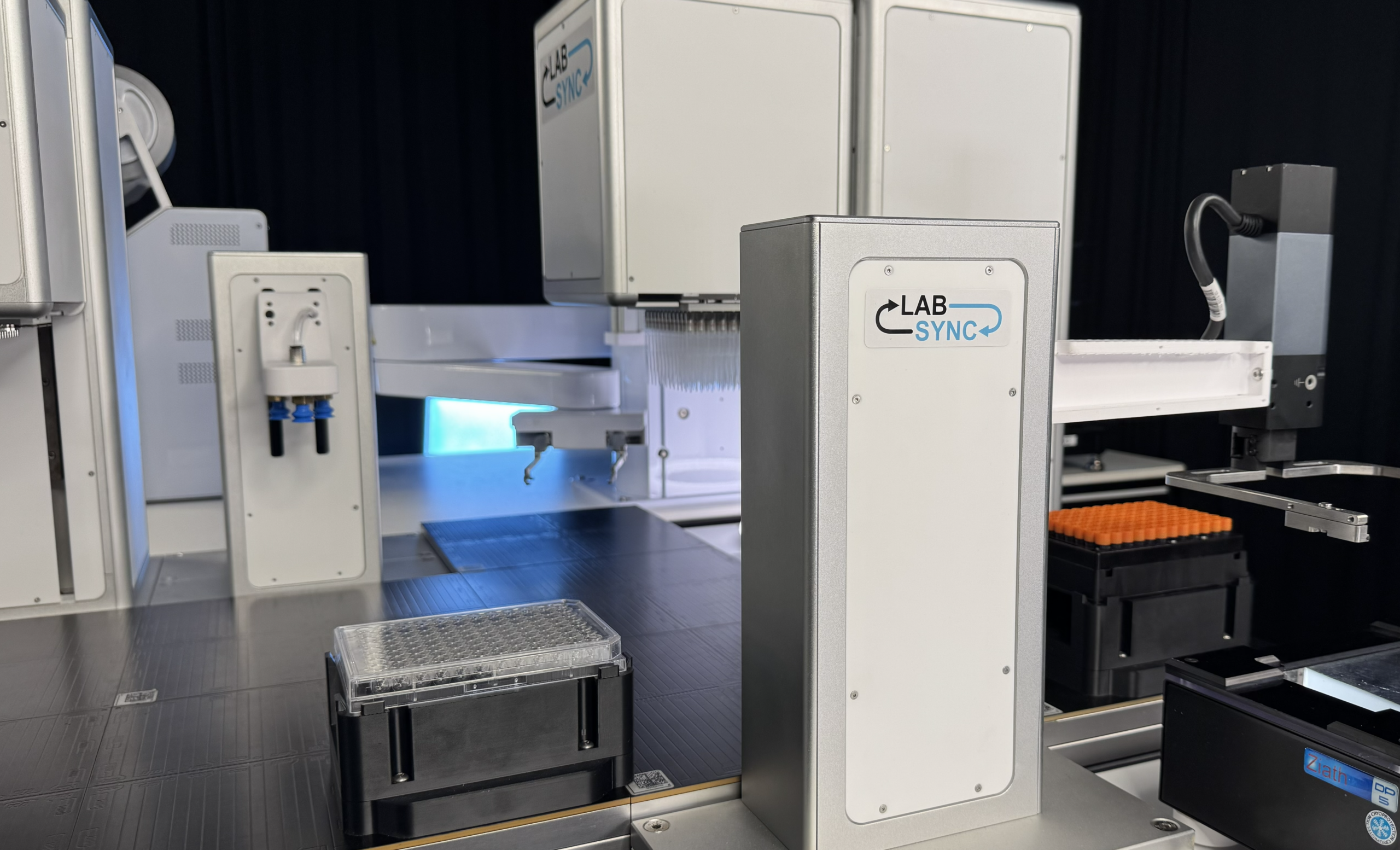
HoverLabs gets more room to build, integrate, and demonstrate.
HoverLabs is our planar platform: electromagnetically levitated shuttles moving multiple samples to multiple devices at once, in the footprint of a tile. It works at the transport layer, removing idle time around labware load and unload so instruments spend more of their day doing the work they were bought to do. Demonstrating it well requires it to be set up and running, integrated with real devices, not disassembled between visits. The expanded floor gives it more room for exactly that.

The Mobile Robot Lab Assistant gets more room to stage and test.
A mobile robot is only proven once you have watched it run, and a fleet is only proven once you have watched the units coordinate with each other in a space with people moving through it. That takes open floor area, and the expansion gives us more of it. The added room means every unit can be run before it ships, individually and as part of a fleet, on our floor rather than on yours.
Growth in one line no longer competes with the other for the floor. Both can scale on their own schedule.
Room for manufacturing and custom builds
Not every automation need fits a standard configuration. A growing part of our work is custom and integrated builds, shaped around a specific lab, a specific workflow, or a specific set of instruments. The expansion gives us more room to take that work on, from manufacturing through integration, so it runs alongside our core platform builds instead of competing with them for space. For customers with a challenge that does not fit off the shelf, that added room means we can take on more of the work and carry it through the same build and test discipline we apply to everything else.
Inside the expanded floor
The added space is adjacent to our existing San Diego floor and connects directly into it, so the expansion reads as one larger facility rather than a second location. Rather than carving the new area into fixed, permanent rooms, we are using it to give each kind of work more room to happen without interrupting the others.
Most of the added area supports building, integration, and testing. An automation system holds its footprint from kickoff through validation, so more room here is what lets more systems be in progress at the same time. HoverLabs and our mobile robotics work both get more room to build, integrate, and run. Our manufacturing and custom-build work gets more room to take on systems shaped around a specific lab. And there is more room to bring customers in to see the platforms running.
One customer-facing space is still being finished: a customer demonstration space that we are completing as part of the expansion. The rest of the expanded floor is already set up and in use.
Building, testing, demonstrating, and custom work on the same day.
Almost every constraint we have run into over the last two years came from one activity having to interrupt another because they shared a footprint. The added room means building, testing, demonstrating, and custom work happen on the same day without displacing one another.
Room for live demonstrations
Automation is easier to trust once you have seen it run. We say that often, and we mean something specific by it. Specifications tell you what a system does under the conditions the specification assumes. Watching it run tells you how it behaves when a plate is seated slightly off, when a device is slow to release, when someone walks past. Those are the moments that determine whether a system works in a real lab, and no document conveys them.
Until now, hosting a customer to see a platform running meant temporarily using space that was doing something else, which capped how many visits we could host and how good each one could be. The expansion gives us more room for this, including a customer demonstration space that we are completing now. Once it is finished, it will give visiting teams a clearer, closer look at HoverLabs and our mobile robots working. In the meantime, the rest of the expanded floor is already in use, and we are hosting customer conversations on it today.
If you are evaluating automation right now, this is the part of the expansion we would most encourage you to use. Come see it. Bring your labware. Bring the workflow you are trying to automate, including the part of it you think will be difficult. The visit is more useful to both of us when it is specific.
A good visit usually runs a few hours and looks less like a tour than a working session. We run the platforms. You watch a handoff happen a dozen times and form your own opinion. We walk your workflow step by step and are honest about which parts are straightforward, which parts need engineering, and which parts we would advise you not to automate yet. Some of the most useful visits we have hosted ended with a customer deciding to scope their project differently than they arrived planning to. That is a good outcome, and it is much more likely to happen in a room with running hardware in it than on a call.
Room for the venture studio we are developing
The expansion also gives us more room for the Lab Sync venture-studio work we are developing. The studio is how we explore new automation ideas alongside our core platforms. Having room for that work under the same roof, near the same engineering talent and test capacity, is what makes it practical: proximity is an underrated form of infrastructure. There is more to share here in time.
What the expansion does not change
- We are not becoming a volume manufacturer.
Our systems are built to order, around a customer’s workflow, their devices, and their constraints. More space lets us run more of those builds concurrently. It does not turn them into units off a line, and we would not want it to. The reason customers come to us is that the system fits their lab, and that requires the same engineering attention it always has.
- More space does not by itself mean faster.
Capacity is only as good as the team using it. The people building in this space have collectively placed more than 30 mobile robots over their careers, and that experience is what turns a bay into a delivered system. We are growing the team alongside the floor, at a pace where new people are trained rather than thrown at a queue.
- The standard does not move.
Every system still gets run and validated before it leaves. The expansion adds where that happens and how many can happen at once. It does not add shortcuts.
What this means if you are waiting on a system
If you have a project with us, the practical effect is capacity. The added space lets us support more work in parallel, which is intended to help builds start sooner and share less of the team’s attention with the one ahead of it.
If you are evaluating, the practical effect is that the conversation can move faster and be more concrete. We can host you sooner. We can show you the platform running rather than describing it. And if you are further out and simply want to understand the options, our doors are open for that too. Not every visit needs to be attached to a project.
Want to see thescaled-up operationfor yourself?
Book a visit to our San Diego facility and see HoverLabs and our mobile robots running on the expanded floor. We are booking visits through the fall, and November is a great month, before the year-end slowdown.
We’ll talk about the expansion, where both platforms are headed, and our manufacturing and custom-build work.
More space. More capacity. More automation delivered.
Frequently asked questions
How much did Lab Sync expand its facility?
We more than doubled our San Diego footprint, from 2,094 to 4,587 square feet, by adding 2,493 square feet of adjacent space that connects into our existing facility. The added area supports building, integration, and testing for both product lines, manufacturing and custom builds, and customer demonstrations.
Is Lab Sync moving to a new location?
No. This is an expansion of our existing San Diego facility. The additional space is adjacent to our current floor and connects directly into it.
Will the expansion make delivery faster?
The expansion increases how many systems we can build and test at the same time, supporting more work in parallel and intended to enable faster delivery. We are keeping that qualitative rather than committing to a specific timeline.
What is the HoverLabs planar platform?
HoverLabs is our planar transport platform. Electromagnetically levitated shuttles move multiple samples to multiple devices at once in the footprint of a tile. It works at the transport layer, removing idle time around labware load and unload so instruments spend more of their day running.
What is the Mobile Robot Lab Assistant?
It is our autonomous mobile robot platform for moving labware and materials between instruments and areas of the lab. The expanded facility gives us more room to stage and test units before they ship, individually and as part of a coordinating fleet.
Can I visit and see the platforms running?
Yes. The expansion adds more room for customer demonstrations, and a customer demonstration space is currently being completed. We host customer visits year-round. Bring the workflow you are trying to automate, including the difficult part of it, and we will find a time.
What is the Lab Sync venture studio?
It is how we explore new automation ideas alongside our core platforms. The expansion gives that work more room under the same roof. We are keeping details at the studio level for now and will share more in time.